8 Revelations About the Hidden Atomic Dance of Relaxor Ferroelectrics
For decades, relaxor ferroelectrics have quietly powered the technologies we depend on—from medical ultrasound imagers to naval sonar systems. Yet, despite their ubiquity, the atomic-level structure that gives them their remarkable properties remained stubbornly shrouded in mystery. That all changed when a team of MIT researchers finally cracked the code, mapping the three-dimensional arrangement of electric charges within these materials at an unprecedented nanoscale resolution. This breakthrough isn't just a win for physics; it's a roadmap for designing next-generation high-tech materials. Here are the key takeaways from this landmark discovery.
1. What Makes Relaxor Ferroelectrics So Special
Unlike standard ferroelectrics, which have a simple, orderly polarization that switches neatly when an electric field is applied, relaxor ferroelectrics exhibit a complex, fuzzy response. They can convert mechanical energy (like sound waves) into electrical signals with incredible efficiency, and vice versa. This makes them ideal for ultrasound transducers, sonar, and precision actuators. But the very feature that makes them useful—their "relaxor" behavior, where polarization doesn't vanish at a single temperature but gradually decays—also made them a puzzle. For 60 years, scientists couldn't directly see how the atoms arranged themselves to create this effect.
2. The Old Model: A Cartoon of Chaos
Previously, researchers assumed that relaxors were made of randomly oriented nanodomains—tiny regions where electric dipoles (positive and negative charge pairs) point in the same direction. These nanodomains were thought to be scattered like a shuffled deck of cards, with no overall pattern. That picture explained some properties, like the broad phase transition, but couldn't account for others, such as the extremely high piezoelectric response (conversion of stress to electricity). The MIT work proves that this random model is wrong.
3. The Breakthrough: 3D Atomic Mapping
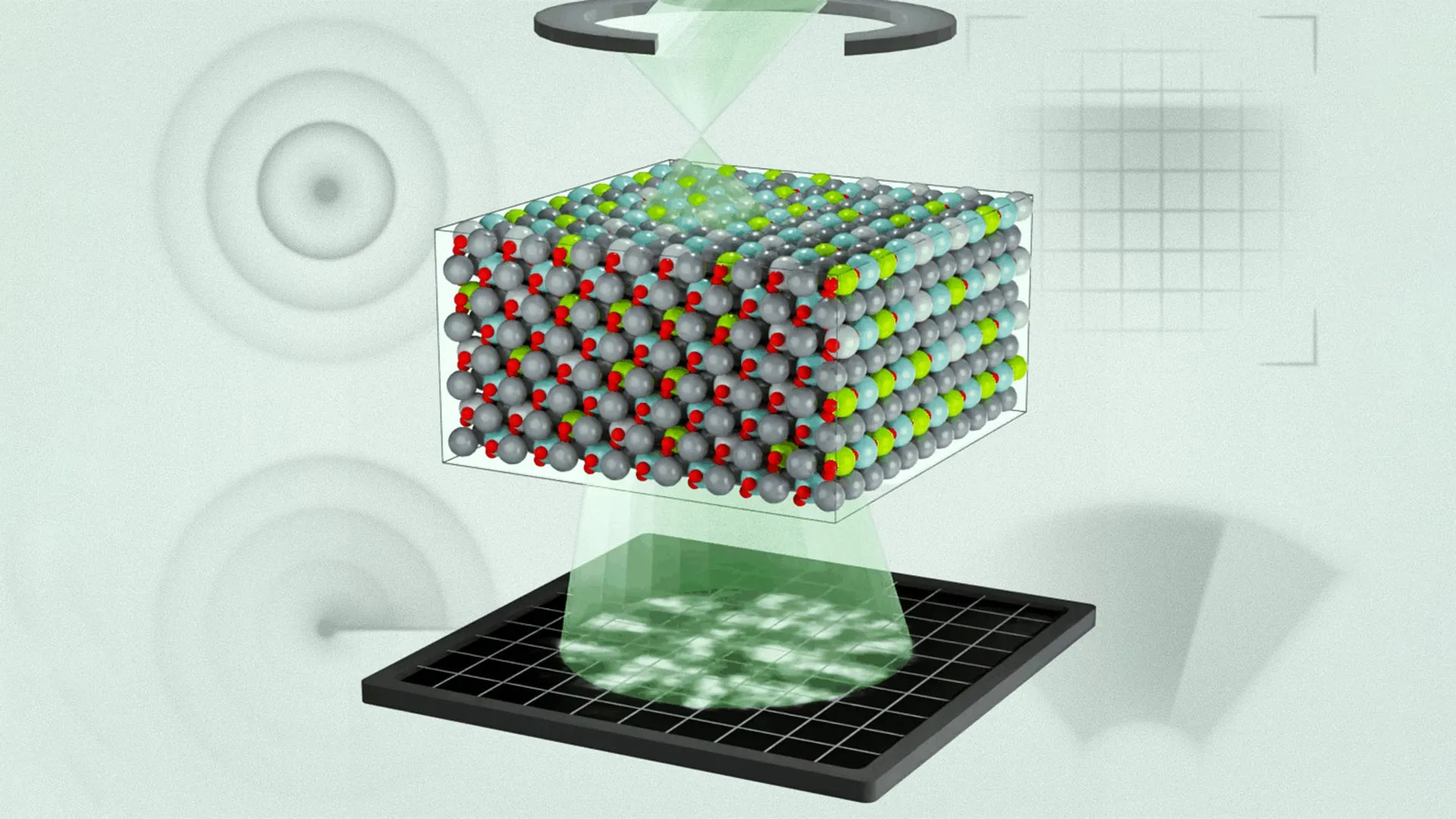
Using a combination of advanced transmission electron microscopy techniques—including scanning transmission electron microscopy (STEM) and electron holography—the MIT team could pinpoint the positions of individual atoms in a relaxor ferroelectric crystal (a compound of lead, magnesium, niobium, and oxygen, known as PMN-PT). They then constructed a three-dimensional map of the atomic displacements. For the first time, they could see that the nanodomains aren't random; they form an ordered, hierarchical structure extending across many layers of atoms.
4. The Hidden Order: "Polar Nanoregions" with a Twist
The map revealed that what were once thought to be simple nanodomains are actually "polar nanoregions" (PNRs)—clusters of dipoles that polarize in a coordinated way. But crucially, these PNRs are not randomly oriented. Instead, they arrange themselves along specific crystallographic directions, forming a lattice-like pattern at the mesoscale (a few nanometers). Moreover, these regions are surrounded by a matrix of disordered atoms, like islands in a sea of chaos. The interplay between the ordered PNRs and the disordered matrix is what gives rise to the relaxor's unique properties.
5. How They Did It: A Technical Masterstroke
To achieve this atomic-level 3D reconstruction, the researchers had to overcome immense challenges. Traditional electron microscopy gives a 2D projection; a 3D map requires tilting the sample and combining images—a process called electron tomography. But relaxor materials are extremely sensitive to the electron beam, which can damage or alter their structure. The MIT team used a low-dose technique, capturing many images with minimal exposure and then aligning them with sophisticated algorithms. They also employed atomic-resolution imaging in multiple orientations to build up the full 3D picture.
6. Why This Changes Everything for Material Design
With the true structure now known, scientists can create realistic computer models of relaxors. Previous models relied on the incorrect random-domain assumptions, leading to predictions that didn't match experiments. Now, models can incorporate the actual hierarchical ordering, enabling precise simulation of properties like piezoelectric response, dielectric constant, and phase transitions. This is a game-changer for designing new relaxors by design—for example, creating materials with even higher sensitivity for medical imaging or with better stability for energy harvesting.
7. Impact on Current Technology: Better Ultrasounds and Sonar
Already, relaxors are key components in medical ultrasound transducers, where they convert electrical pulses into sound waves and then detect the returning echoes. The new understanding will help engineers optimize the materials for sharper imaging and deeper penetration. Similarly, naval sonar systems rely on these materials to detect submarines under water. With refined models, sonar arrays could become more sensitive and less prone to noise, giving navies a clearer picture of underwater environments. Consumer electronics, like piezoelectric buzzers and actuators, will also benefit.
8. The Future: Beyond PMN-PT to New Families of Relaxors
The MIT team focused on the classic relaxor PMN-PT, but their method can be applied to many other compounds, such as those based on bismuth, barium, or even lead-free relaxors (important for environmental regulations). By revealing the universal principles of polar nanoregion ordering, the work paves the way to engineer relaxors from scratch. Imagine custom materials that operate efficiently at high temperatures, withstand high stresses, or are flexible enough for wearable devices. That future is now one step closer, thanks to the hidden structure finally being brought to light.
In summary, the revelation of the ordered polar nanoregions in relaxor ferroelectrics overturns decades of assumptions and provides a solid foundation for the rational design of advanced piezoelectric and dielectric materials. This is not just an academic curiosity; it's a practical tool that will accelerate the development of better medical devices, military technology, and consumer electronics. The hidden dance of atoms has been choreographed, and engineers are ready to join the dance.
Related Articles
- Revolutionizing Violin Design: MIT's Physics-Based Virtual Instrument
- Mastering CSS rotateX(): A Step-by-Step Guide to 3D Vertical Rotation
- Unveiling Star Formation Secrets: Webb and Hubble's Deep Dive into the Whirlpool Galaxy
- How a 50,000-Member Online Community Fueled a 6,000% Surge in AST Stock: Q&A
- Underrated Anime ‘A Hundred Scenes of Awajima’ Captures Spotlight-Seeking Human Nature in Stunning Detail
- How to Support Space Advocacy: A Guide to Astronauts for America
- Mars Rover Curiosity's Sticky Situation: The Tale of the Atacama Rock
- Neanderthal Dentistry: Decoding the 60,000-Year-Old Drilled Tooth