Why V8 Set Sail from the Sea of Nodes: 7 Key Reasons
For over a decade, V8's top-tier optimizing compiler, Turbofan, relied on an unconventional intermediate representation known as the Sea of Nodes. This approach, while innovative, gradually revealed its limitations. Over the past three years, V8 has been charting a new course, migrating to a more traditional control-flow graph (CFG) intermediate representation called Turboshaft. Today, the entire JavaScript backend of Turbofan has made the switch, and WebAssembly uses Turboshaft throughout its pipeline. Only a few remnants of the Sea of Nodes remain—in the builtin pipeline (slowly being replaced) and in the JavaScript pipeline's frontend (being overtaken by Maglev, another CFG-based IR). What drove this major architectural shift? Let's explore the seven pivotal reasons behind V8's decision to leave the Sea of Nodes behind.
1. Escalating Technical Debt in Crankshaft
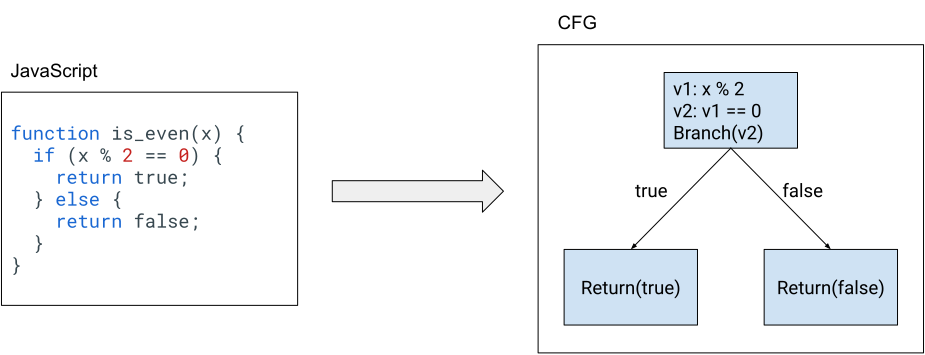
V8's earlier optimizing compiler, Crankshaft, was built on a CFG-based IR but quickly accumulated technical debt. As the team added features and optimizations, the codebase became increasingly brittle and hard to maintain. Extending Crankshaft to support new JavaScript constructs or performance improvements often required wrestling with legacy design choices. The Sea of Nodes was initially adopted to overcome some of these limitations—its flexible graph structure promised better optimization opportunities. However, the very flexibility of the Sea of Nodes introduced its own set of complexities, making the compiler harder to reason about and debug. After years of struggling with both approaches, the V8 team concluded that a clean-slate CFG-based IR would provide a more sustainable foundation for future development, leading to the creation of Turboshaft.
2. Too Much Hand-Written Assembly Code
One of the most painful issues with Crankshaft was its heavy reliance on hand-written assembly code. Every new IR operator had to be manually translated to machine code for each of V8's four supported architectures (x64, IA32, ARM, and ARM64). This was not only tedious and error-prone but also slowed down development significantly. The Sea of Nodes tried to mitigate this by enabling higher-level optimizations, but the backend still required architecture-specific code generation. Turboshaft addresses this by using a more structured lowering process, where high-level operations are progressively broken down into low-level instructions through a series of predefined passes. This reduces the need for manual assembly and makes it far easier to port new features across architectures. The result is a more maintainable and faster-evolving compiler.
3. Inability to Add Control Flow During Lowering
In Crankshaft, control flow was determined at graph building time and remained fixed thereafter. This was a major limitation because modern compilation often requires introducing branching logic as high-level operations are lowered to low-level ones. For example, a simple addition like JSAdd(x, y) might need to be lowered into a conditional that checks whether the operands are strings or numbers before choosing the appropriate addition routine. Without the ability to create new control flow during lowering, Crankshaft forced engineers to either pre-enumerate all possible paths or sacrifice optimization opportunities. The Sea of Nodes solved this by allowing arbitrary control flow changes within the graph, but the overhead of maintaining that flexibility proved high. Turboshaft strikes a better balance: it permits control flow insertion during lowering, but within a CFG framework that is simpler to analyze and optimize.
4. No Support for Try-Catch Blocks
Try-catch statements are fundamental to modern JavaScript error handling, yet Crankshaft stubbornly refused to optimize them. Multiple engineers spent months attempting to add try-catch support, but the architectural hurdles were insurmountable. The Sea of Nodes offered a glimmer of hope by enabling more flexible graph transformations, but even with that, implementing robust try-catch support proved challenging. Turboshaft was designed from the ground up to handle exceptional control flow gracefully. Its CFG-based representation includes explicit edges for exception paths, making it straightforward to generate optimized code for try-catch blocks without sacrificing performance. This single improvement has significant real-world impact, as applications that rely on error handling no longer suffer from severe performance degradation.
5. Performance Cliffs and Frequent Bailouts
Under Crankshaft and even the early Sea of Nodes implementation, developers often encountered dramatic performance cliffs. Using a particular JavaScript feature or encountering an edge case could cause a 100x slowdown. These cliffs forced developers to write convoluted workarounds and made it nearly impossible to predict how code would perform in production. The root cause was the compiler's tendency to bail out of optimization when it encountered unexpected patterns, falling back to a slower interpreter. While the Sea of Nodes allowed more aggressive optimizations, it also increased the likelihood of such bailouts due to its complexity. Turboshaft tackles this by focusing on stability and predictability. The CFG design makes it easier to ensure that optimizations are applied consistently, reducing the number of performance cliffs and making V8's behavior more predictable for JavaScript developers.
6. Deoptimization Loops
A particularly frustrating issue in V8's optimizing pipeline was the deoptimization loop. The compiler would optimize a function using speculative assumptions — for example, assuming a variable always holds a particular type. If that assumption proved wrong, the function would be deoptimized, and execution would fall back to the interpreter. However, too often, the optimizer would then reoptimize the same function with the same unsound assumptions, leading to a cycle of optimization and deoptimization that tanked performance. The Sea of Nodes, despite its flexibility, struggled to break these cycles because its graph transformations made it difficult to track and avoid repeated speculative decisions. Turboshaft's more rigid structure allows the compiler to maintain better metadata about which assumptions have already failed, preventing deoptimization loops and ensuring that optimizations are both safe and effective.
7. A Need for a More Maintainable Architecture
Underlying all the specific issues was a growing recognition that the Sea of Nodes architecture had become a maintenance burden. The compiler team found it increasingly difficult to onboard new engineers, debug optimization failures, and implement new language features. The graph-based representation required complex algorithms for traversing and transforming nodes, and the lack of a clear ordering made reasoning about optimization passes difficult. Turboshaft, based on a conventional CFG, offers a simpler mental model: a sequence of basic blocks with explicit control flow. This makes it easier to write and verify optimizations, reduces the barrier for new contributors, and improves overall code quality. The migration to Turboshaft is not just about fixing past problems; it's about building a compiler that V8 can evolve for the next decade.
As of today, the transition is well underway. The JavaScript backend of Turbofan has fully adopted Turboshaft, and WebAssembly uses it throughout its pipeline. The builtin pipeline still relies on some Sea of Nodes code but is being gradually replaced, while the JavaScript frontend is being revitalized with Maglev, another CFG-based compiler. With a cleaner architecture and improved performance characteristics, V8's shift from the Sea of Nodes to Turboshaft marks an important chapter in the engine's evolution. For developers, this means more consistent performance, fewer surprises, and a more reliable JavaScript runtime.
Related Articles
- Security Blind Spots in AI Skill Scanners: How Test Files Bypass Detection
- Massachusetts Secures $1.4 Billion in Savings Through Long-Term Offshore Wind Contracts
- ESS to Manufacture Alsym's Sodium-Ion Battery: A Game Changer for Grid Storage?
- Unpacking Tim Cook's Apple Acquisition Strategy: A Mix of Hardware, Software, and Services
- Integrating Electric Trailers into Your Fleet: A Step-by-Step Guide to Reducing Costs and Supporting Grid Stability
- Choosing the Right Exposure Management Platform: Key Features and Common Pitfalls
- China's Electric Vehicle and Energy Storage Revolution: Insights from the Beijing Auto Show and Beyond
- Australia's Green Iron Promise Slips as Global Rivals Accelerate: Urgent Action Needed