Google's V8 Engine Introduces Speculative Optimization for WebAssembly, Delivering Up to 50% Performance Gains
Breaking News: Google has shipped a major performance upgrade for WebAssembly in Chrome M137. The V8 JavaScript engine now employs speculative optimizations—including deoptimization support and inline caching—that boost execution speed by over 50% in certain cases. This marks a paradigm shift for WebAssembly, which previously relied on static type information and ahead-of-time compilation.
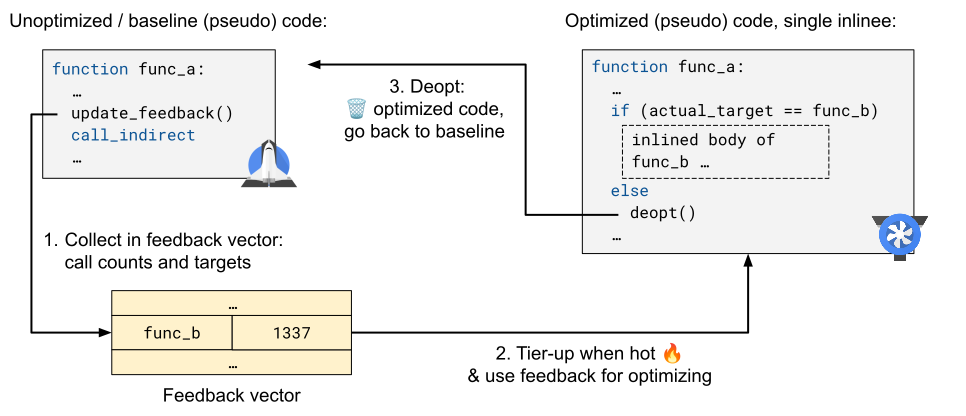
The new optimizations, speculative call_indirect inlining and deoptimization support, allow V8 to generate machine code based on runtime feedback, similar to how modern JavaScript engines optimize hot paths. "This is a game-changer for WasmGC programs," said a V8 engineer. "We can now make assumptions and seamlessly revert if they fail, enabling much faster code."
Performance Gains
On a set of Dart microbenchmarks, the combination of both optimizations yields an average speedup of more than 50%. For larger, realistic applications and benchmarks, the improvement ranges between 1% and 8%. "The 50% improvement on microbenchmarks is just the start," the engineer added. "For larger apps, even single-digit speedups translate to real user-perceptible gains."
The optimizations are particularly impactful for programs compiled to WebAssembly GC (WasmGC), the proposal that brings garbage collection and high-level types to WebAssembly. WasmGC supports rich types like structs and arrays, subtyping, and operations on those types—features that benefit greatly from runtime feedback and speculation. Previous WebAssembly 1.0 binaries, often from C/C++ or Rust, were more straightforward to optimize statically.
Background
Fast execution of JavaScript has long relied on speculative optimizations. JIT compilers collect feedback during earlier executions and generate optimized machine code based on assumptions—for example, that a + b involves two integers. If later execution violates those assumptions, the engine performs a deoptimization (or deopt) by discarding the optimized code and falling back to unoptimized execution. "JavaScript wouldn't be this fast without deopts," explained the engineer.
Until now, WebAssembly didn't need such speculation. Static typing of functions, instructions, and variables allowed compilers like Emscripten (based on LLVM) and Binaryen to produce well-optimized binaries ahead of time. But the introduction of WasmGC changed that calculus. "Higher-level bytecode requires the same kind of adaptive optimization that we use for JavaScript," the engineer noted. "It's a natural evolution."
What This Means
This development opens the door to a new era for WebAssembly performance. Speculative inlining based on observed call targets—a core part of the current optimization—is just one example. Future enhancements could include broader use of runtime types, adaptive branch prediction, and more aggressive tiering strategies. "Deoptimizations are an important building block for further optimizations down the line," the engineer said.
For developers, this translates to faster execution of managed languages like Java, Kotlin, and Dart compiled to WasmGC—without any source code changes. The speedups are immediate once users update to Chrome M137 (or any browser that incorporates the V8 changes). "We're bringing the same optimization philosophy to WebAssembly," the engineer concluded. "This is the start of a much faster WebAssembly ecosystem."
Related Articles
- Chinese EV Makers Set Sights on Canada: What to Expect
- Rugged Android Tablet with Integrated 1080p Projector: The Tank Pad Ultra Review
- Electric Fire Trucks Gain Traction but Fall Behind Buses, Garbage Trucks, and Drayage Fleets in EV Adoption Race
- Flutter and Dart Unveil AI Strategy for 2026 Amid Developer Trust Gap
- Decoding the Tesla Semi's Battery Specs: A Comprehensive Guide
- EU Weakening Methane Rules: 'Major Win for Oil and Gas' Amid Energy Security Pressure
- Historic ASEAN-EU Sustainability Summit Opens in Cebu Ahead of Major Regional Talks
- Flutter & Dart Triumph at Google Cloud Next 2026: Full-Stack Dart, GenUI, and Enterprise Wins