How Oxford Physicists Achieved the First Quadsqueezing: A Step-by-Step Guide to the Breakthrough
Introduction
In a landmark experiment, physicists at the University of Oxford demonstrated a quadsqueezing effect for the first time — an elusive fourth-order quantum phenomenon that makes invisible quantum behaviors accessible. This guide breaks down their approach into a logical, step-by-step process, showing how simple forces can be combined to unlock a new dimension of quantum control. By following these steps, researchers can replicate and build upon this breakthrough for next-generation quantum technologies.
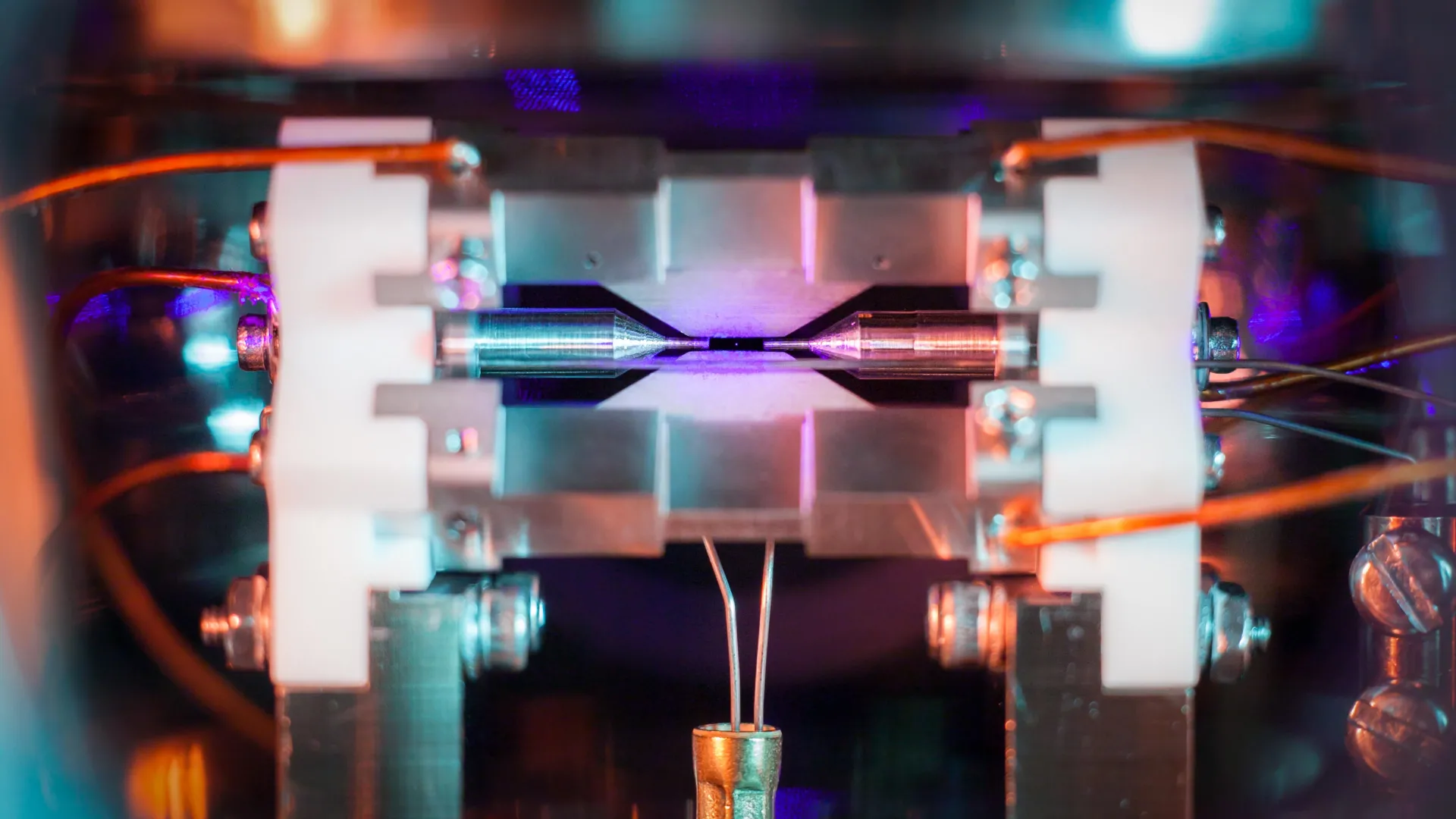
What You Need
- Quantum system: A mechanical oscillator (e.g., a vibrating membrane) or an optical field confined in a high-finesse cavity.
- Linear drive source: A laser or microwave generator capable of applying a coherent force at the system's resonance frequency.
- Nonlinear element: A medium with a χ(3) nonlinearity (e.g., a Kerr medium) or a Josephson junction.
- Phase-control electronics: Lock-in amplifiers and phase shifters to stabilize relative phases of drives.
- Homodyne detection setup: For measuring quadrature variances with high precision.
- Cryogenic environment (for mechanical systems): Dilution refrigerator to cool the oscillator to its quantum ground state.
Step 1: Stabilize the Quantum System
Begin by preparing a clean quantum system with low dissipation. For mechanical resonators, cool the membrane to its motional ground state using cryogenic techniques. For optical systems, use an ultra-high‑finesse cavity to ensure long photon lifetimes. This baseline is essential because quadsqueezing is fragile — any excess noise or decoherence can wash out the fourth‑order signal.
Step 2: Apply a Linear Squeezing Force
Turn on a linear parametric drive at twice the system’s resonance frequency (for a mechanical oscillator) or use a degenerate parametric amplifier in optics. This creates standard (second‑order) squeezing: the variance of one quadrature is reduced below the quantum zero‑point level while the orthogonal quadrature is amplified. The degree of squeezing should be characterized before proceeding.
Step 3: Introduce the Nonlinear Element
Add the nonlinear component to the system. In the Oxford experiment, a clever combination of a linear force and a cubic nonlinearity produced the required fourth‑order effect. For instance, a Josephson junction can provide a Kerr nonlinearity that effectively couples the squeezing to a higher order. Ensure the nonlinear strength is sufficient to overcome inherent damping.
Step 4: Phase-Lock the Two Drives
Now comes the crucial trick: align the phases of the linear drive and the nonlinear interaction. Use a feedback loop and a reference oscillator to lock the relative phase to a specific value — often π/4 or π/2 depending on the system. This synchronization is what makes the fourth‑order effects coherent and observable. Without it, quadsqueezing remains hidden in random fluctuations.
Step 5: Measure the Quartic Quadrature Variance
Employ homodyne detection to extract the output field's quadrature statistics. Instead of the usual second‑order variance (⟨ΔX⟩2), look at the fourth‑order cumulant ⟨ΔX4⟩ – 3⟨ΔX2⟩2. When this becomes negative, it signals genuine quadsqueezing. The Oxford team reported a clear violation of the fourth‑order inequality, proving the effect's existence.
Step 6: Verify and Characterize
Repeat the measurement at different drive strengths and phases to map out the quadsqueezing parameter space. Confirm that the effect scales as the fourth power of the drive amplitude (typical for a fourth‑order process). Also, check for consistency with theoretical predictions — any deviation may indicate experimental artifacts or higher‑order contributions.
Tips for Success
- Thermal isolation: Even tiny thermal fluctuations can mask quadsqueezing. Operate at millikelvin temperatures if using mechanical systems.
- Calibration of nonlinearity: Use a separate pump‑probe experiment to measure the Kerr coefficient before attempting quadsqueezing.
- Phase stability: Active phase locking with a low‑noise feedback loop is non‑negotiable; drift of even a few millidegrees can destroy the effect.
- Data analysis: Use higher‑order statistical tests (e.g., cumulant analysis) to differentiate quadsqueezing from ordinary nonlinear noise.
- Start simple: First demonstrate second‑order squeezing, then gradually adjust parameters to reveal the fourth‑order signal.
This step‑by‑step approach captures the essence of the Oxford breakthrough. By carefully combining linear and nonlinear forces with precise phase control, researchers can now access a new class of quantum states — paving the way for enhanced quantum sensing, fault‑tolerant computation, and deeper exploration of the quantum‑classical boundary.
Related Articles
- Big Tech's Capital Spending Soars to $725 Billion in 2026 – AI and Chip Costs Fuel the Surge
- Amazon WorkSpaces Unveils AI Agent Desktop Access, Eliminating Legacy App Modernization Barrier
- The Role of Genetic Information in Cellular Order and Survival
- Unlocking Nature's Cancer Fighter: How Scientists Decoded the Production of Mitraphylline
- Gut-Brain Axis Shaken: Coffee Rewires Microbiome and Mood, Study Finds
- Boosting Spacecraft Brains: NASA’s High-Performance Spaceflight Computing Project
- How Media Can Cover Ireland's Artemis Accords Signing Ceremony at NASA Headquarters
- The Art of Storytelling in User Research: Engaging Stakeholders Through a Three-Act Structure