How Hermes Agent and Qwen 3.6 Are Revolutionizing Local AI with NVIDIA Hardware
Introduction: The Rise of Agentic AI
Agentic AI is transforming how users accomplish tasks by enabling autonomous, goal-driven assistants. Unlike traditional chatbots, these agents can plan, execute multi-step workflows, and learn from experience. The open-source community has embraced this shift, with frameworks like OpenClaw paving the way. Now, a new leader has emerged: Hermes Agent, developed by Nous Research. Since its release, Hermes has garnered over 140,000 GitHub stars in less than three months and, according to OpenRouter, became the most widely used agent globally as of last week. Its success stems from a focus on reliability and self-improvement — two historically challenging traits for AI agents.
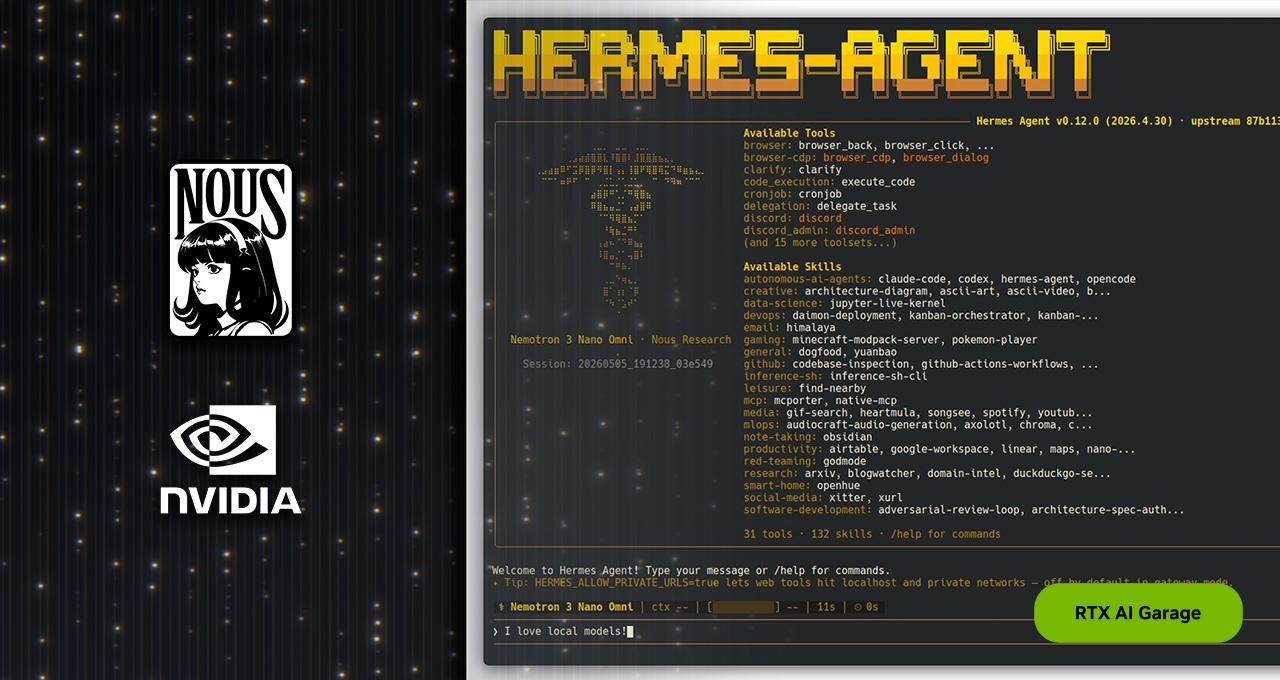
Hermes Agent: Designed for Reliability and Continuous Learning
Hermes is built to be provider-agnostic and model-agnostic, meaning it works seamlessly with various language models and hardware backends. It is optimized for always-on local operation, making devices like NVIDIA RTX PCs, NVIDIA RTX PRO workstations, and NVIDIA DGX Spark the ideal platforms to run it at full speed around the clock. This local-first approach ensures privacy, low latency, and independence from cloud services.
Self-Evolving Skills
One of Hermes' standout features is its ability to write and refine its own skills. Each time the agent tackles a complex task or receives feedback, it saves the learned approach as a reusable skill. Over time, the agent adapts and improves autonomously, reducing the need for manual intervention.
Contained Sub-Agents for Efficient Task Management
Hermes treats sub-agents as short-lived, isolated workers dedicated to a single sub-task. Each sub-agent operates with a focused context and a limited set of tools. This design keeps task organization tidy, minimizes confusion for the main agent, and allows Hermes to run with smaller context windows — an advantage when using local models with limited memory.
Reliability by Design
Nous Research carefully curates and stress-tests every skill, tool, and plug-in that ships with Hermes. The result is an agent that just works
, even with 30-billion-parameter local models. Users avoid the constant debugging required by most other agent frameworks.
Same Model, Better Results
Developer comparisons using identical models across different frameworks consistently show stronger outcomes with Hermes. The difference lies in the framework itself: Hermes acts as an active orchestration layer, not a thin wrapper. This enables persistent, on-device agents rather than task-by-task execution, leading to more coherent long-term interactions.
Hardware That Unlocks Local AI Potential
Both the Hermes agent and the underlying language models are designed for local deployment. Consequently, the quality of hardware directly determines the user experience. NVIDIA RTX GPUs are purpose-built for such workloads, offering the parallel processing power needed for real-time inference and agent loop execution. The contained sub-agent design further benefits from GPU acceleration, allowing multiple isolated tasks to run concurrently without bottlenecking the main agent. NVIDIA DGX Spark, with its dedicated AI compute, ensures that even demanding agent workflows remain responsive 24/7.
Qwen 3.6: Data Center-Level Intelligence on Your Desktop
Alibaba's latest Qwen 3.6 series of open-weight large language models (LLMs) brings unprecedented performance to local agents. The Qwen 3.6 27B and 35B parameter models outperform their previous-generation 120B and 400B counterparts by a wide margin — yet they require far less memory. For instance, the 35B model runs on roughly 20GB of VRAM, while the older 120B model needed over 70GB. This efficiency makes high-quality local AI accessible to users with consumer-grade NVIDIA GPUs.
Model Details and Benchmarks
The Qwen 3.6 27B is a dense model with more active parameters per token, matching the accuracy of the previous 400B model while being drastically smaller. Both new models integrate seamlessly with Hermes, benefiting from the agent's orchestration layer to achieve top-tier results. When paired with NVIDIA RTX GPUs or DGX Spark, users can run these models at full speed, experiencing low-latency interactions comparable to cloud-based solutions.
Conclusion: The Synergy of Open-Source Innovation and Powerful Hardware
The combination of Hermes Agent, Qwen 3.6 LLMs, and NVIDIA's local compute hardware marks a milestone in agentic AI. Users no longer need to sacrifice performance for privacy or reliability. With self-improving skills, efficient sub-agent management, and a curated ecosystem, Hermes is redefining what's possible on local machines. As the community continues to contribute skills and tools, the gap between cloud and local AI will only shrink. For developers and power users, now is the time to explore this new frontier.
Related Articles
- From Feedback to Fixes: A Step-by-Step Guide to Building an AI-Powered Accessibility Workflow at GitHub
- OpenClaw Takes GitHub by Storm: What Autonomous 'Claw' AI Agents Mean for Enterprise Security
- Python 3.13.10 Released: A Detailed Look at the Latest Maintenance Update
- Rust Project Embraces Diversity with Outreachy Internship Program
- How to Successfully Change Your Open Source Project's License
- How to Maximize Your GitHub Copilot Subscription: Understanding Pro, Pro+, and the New Max Plan
- Open Source Documentary Series Explores Unsung Heroes of the Internet
- Ploopy Bean: The Open-Source Pointing Stick Mouse That Puts You in Control