How to Analyze Ransomware Threat Landscape Data: A Q1 2026 Guide
Overview
Understanding the state of ransomware requires more than watching the news. The Q1 2026 data reveals a critical shift: the ecosystem is consolidating after a period of fragmentation, volumes remain historically high, and new actors are rising. This tutorial guides you through the key metrics and trends from Q1 2026, step by step, so you can interpret raw data, avoid common misinterpretations, and apply these insights to your threat modeling or security strategy. By the end, you'll know how to read data leak site (DLS) statistics, adjust for one-off campaigns, and spot shifts in group dominance.
Prerequisites
- Basic familiarity with ransomware terms: data leak sites (DLS), victim counts, group names (e.g., LockBit, Qilin).
- Access to data – either a copy of the Q1 2026 ransomware tracking dataset (e.g., from a commercial intelligence provider or community reports).
- Optional: A spreadsheet tool or Python (with pandas) to perform calculations manually.
- Curious mindset – you're expected to question headline numbers and dig into underlying drivers.
Step-by-Step Guide
Step 1: Identify Consolidation Trends
In Q1 2026, the number of active ransomware groups dropped from 85 to 71. Fourteen groups that were active in Q4 2025 vanished entirely, while 21 new names appeared. The top 10 groups now account for 71.1% of all DLS-posted victims – the highest concentration since early 2024. To replicate this analysis:
- Count the total number of groups that posted at least one victim in each quarter.
- Sum the victim counts of the top 10 groups and divide by total victims for that quarter. Multiply by 100 to get percentage.
- Compare quarter-over-quarter. In Q3 2025, the top-10 share was 57%; in Q1 2026 it rose to 71% – a reversal of the fragmentation trend.
Example (pseudo-code / Python):
# Assuming df has columns 'group_name' and 'victims'
total_victims = df['victims'].sum()
top10 = df.groupby('group_name')['victims'].sum().nlargest(10).sum()
share = (top10 / total_victims) * 100
print(f'Top-10 share: {share:.1f}%')
Step 2: Analyze Attack Volume Stability
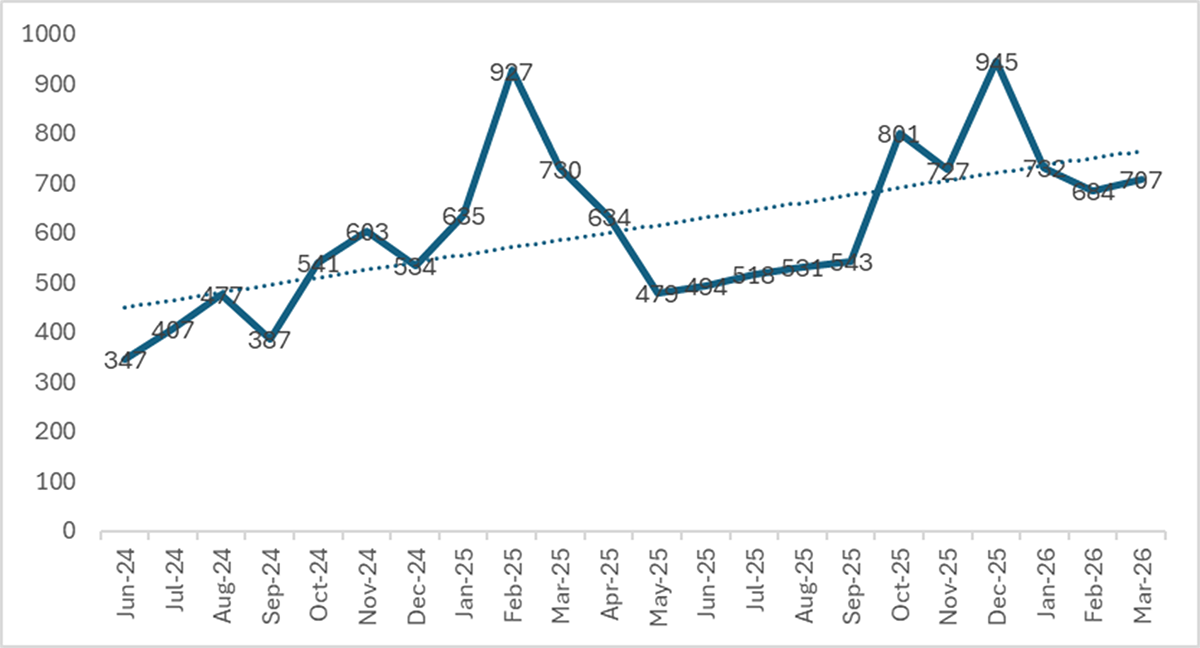
Monthly volumes in Q1 2026 were remarkably steady: January 732, February 684, March 706 – averaging 707 per month. That's the second-highest Q1 on record, 117% above Q1 2024 (977). While the all-time record was Q4 2025 (2,416), the decline is modest given the extreme spike caused by Cl0p. To assess stability:
- Compute monthly totals and compare to the same period in prior years.
- Calculate the coefficient of variation (standard deviation / mean) across months. For Q1 2026 it's about 3%, indicating very low volatility.
This stability suggests ransomware-as-a-service operations have reached a mature operating tempo – not a fad or one-off surge.
Step 3: Evaluate Dominant Actors
Three groups stand out:
- Qilin – maintained top spot for third consecutive quarter with 338 victims.
- The Gentlemen – breakout story: from 40 victims in Q4 2025 to 166 in Q1 2026 (315% increase).
- LockBit 5.0 – posted 163 victims and climbed to fourth place after a comeback.
To track dominance, compute a group's market share (its victims divided by total). For example, Qilin's share = 338 / 2122 ≈ 15.9%. Compare with previous quarters to see if it's growing or declining.
Step 4: Adjust for One-Off Campaigns
The headline year-over-year comparison shows a 7.1% decline from Q1 2025 (2,285) to Q1 2026 (2,122). However, Q1 2025 was inflated by Cl0p's Cleo mass-exploitation campaign (~390 victims in a single burst). If you exclude Cl0p from both periods, you get 1,894 (Q1 2025) vs. 1,995 (Q1 2026) – a 5.3% increase. Always ask:
- Are there any large-scale exploitation events (e.g., vulnerabilities in Cleo, MOVEit)?
- Remove those groups' victims from both sides and recalculate.
- Adjusting gives a truer picture of underlying growth.
Step 5: Compare Top-10 Share Over Time
Plot the top-10 share over the last two years. You'll see:
- Q1 2024: 68%
- Q3 2025: 57% (peak fragmentation, 85 active groups)
- Q1 2026: 71% (consolidation)
Interpretation: The ecosystem is weeding out weaker or smaller groups, while dominant operators scale their infrastructure. This makes it easier to track and defend against the top threats, but also means those top groups become more dangerous.
Common Mistakes
Mistake 1: Taking Year-over-Year Numbers at Face Value
As shown above, the superficial 7.1% decline does not tell the real story. Failing to adjust for Cl0p's campaign leads to underestimating the persistent growth. Always read the footnotes and understand what drove past spikes.
Mistake 2: Overlooking Group Churn
If you only focus on the top 10, you miss that 14 groups disappeared and 21 new ones emerged. This churn indicates a dynamic underground economy where groups rebrand, merge, or get shut down by law enforcement. Keeping a list of active groups is essential for detection rules.
Mistake 3: Confusing Volume with Fragmentation
High victim counts do not automatically mean the threat is more diffuse. In Q1 2026, volumes were high AND consolidation was occurring. Always look at concentration metrics (e.g., Herfindahl-Hirschman Index or top-10 share) alongside raw numbers.
Summary
Q1 2026 ransomware data shows that after two years of fragmentation, the top 10 groups now control 71% of victims – the highest concentration in two years. Volumes remain near all-time highs, with a stable monthly average of 707 victims. Qilin leads, The Gentlemen surged, and LockBit made a comeback. Crucially, the superficial YoY decline masks real growth when adjusted for Cl0p's campaign. To analyze ransomware data correctly, always normalize for one-off events, track group churn, and monitor consolidation versus fragmentation trends.
Related Articles
- Revolutionizing Multi-Agent AI: How RecursiveMAS Cuts Token Costs by 75% and Boosts Speed
- Microsoft Unleashes Agentic AI Platform for R&D, Claims Breakthrough in Scientific Discovery
- Climate Scientist Warns 2026 on Track to Shatter Global Heat Record
- 10 Key Insights into Ireland's Signing of the Artemis Accords
- 7 Subtle Ways AI Is Undermining the Human Glue That Makes Teams Strong
- How to Deploy an Ultrathin, Stretchy Radiation Shield for Future Spacecraft
- 5 Essential Steps to Rediscover Meaning and Purpose in Your Life
- 8 Fascinating Facts About the Pleiades 'Seven Sisters' and Their Ghostly Blue Veil